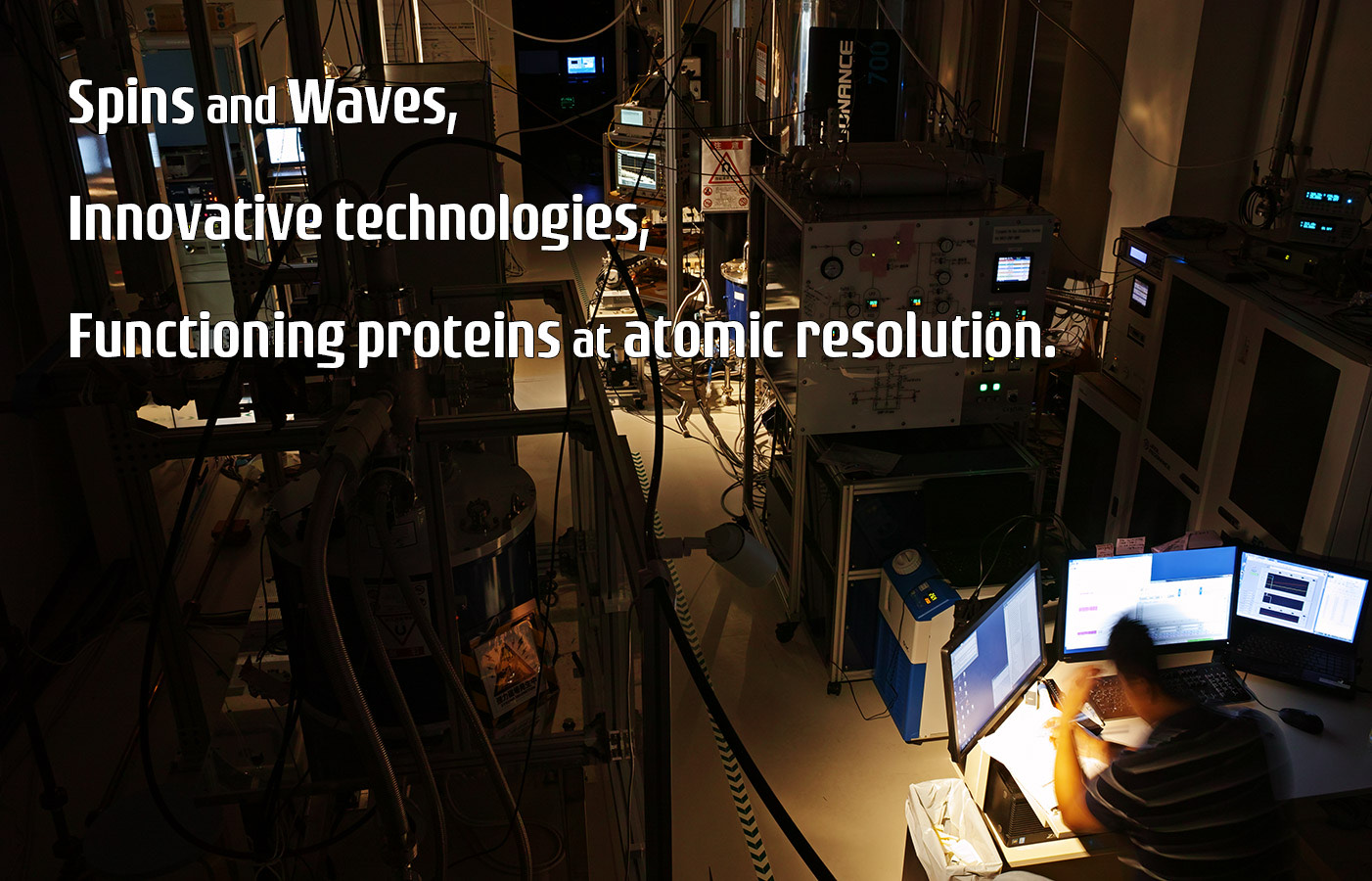
The measurement method we are focusing on is solid-state nuclear magnetic resonance (NMR) spectroscopy, also known as MAS-NMR.
We can observe the three-dimensional structure, ensemble distribution, chemical structure, and mobility of molecular assemblies that are insoluble, amorphous, or neither liquid nor rigid solid, at atomic resolution.
We have also developed equipment and techniques for spin hyperpolarization (DNP), and have succeeded in achieving ultra-high sensitivity in solid-state NMR.
This allows us to visualize even ultra-trace molecules that were previously invisible due to sensitivity limitations.
Furthermore, we have created a nanodiamond polarizing agent (PA) that does not deactivate at all within cells, and a nano-space selection method that selectively observes only target molecules,
This gives us a technology that is extremely unique in the world, enabling targeted observation in the congested environment of cells.
In this way, we have made it possible to conduct science that intelligently translates what is "not normally visible" into structural design.
We are widely applying this to bio, chemistry, and materials research!
In our lab, we study how proteins/protein assemblies express their functions based on the information of their 3-dimensional (3D) molecular structures. We combine nuclear magnetic resonance (NMR) spectroscopy, molecular biological techniques, and bioinformatics methods to determine protein structures in atomic-resolution.
We also develop methods and instruments for solid-state NMR spectroscopy. Instrumentation for dynamic nuclear polarization (DNP) that enables orders of magnitude sensitivity improvement deserves most of our time and efforts. Methods for non-uniform data sampling (NUS) and for fast MAS-proton detection techniques would also take an important part of the development.
We mainly focus our attention on signal/ion transducing membrane proteins and functional/pathogenic fibrous protein assemblies. Studying behaviors of these systems in intact cells is also one of the main projects. On-going collaboration with the University Hospital is interested in potential relationships between morphology of pathogenic fibrils and disease phenotypes.


