



ACHIEVEMENTSIPR The University of Osaka
-

- ACHIEVEMENTS
- Immune remodeling in extreme old age: how supercentenarians reshape their immune system
Press Release
2026.08.25
Immune remodeling in extreme old age: how supercentenarians reshape their immune system
Researchers from the University of Osaka uncover an unusual immune cell that expands in supercentenarians and may help protect against cancer and other age-related threats
Osaka, Japan – Aging while maintaining good health is a priority for many populations. This is often difficult considering that the risk of certain diseases increases with age, alongside weakened immunity to illnesses that younger individuals could easily overcome. This has raised an important question for researchers: why do some people live to a very old age while avoiding major diseases?
However, answers may come from new research, conducted by a team at the University of Osaka, involving Japanese supercentenarians aged 110 years and older. The findings suggest that a rare type of immune cell becomes increasingly abundant with extreme age. The findings are set to be published in Cell Reports.
One class of immune cells, called T cells, are traditionally divided into two groups: helper cells that coordinate immune responses, and killer cells that destroy infected or cancerous cells. However, supercentenarians accumulate an unusual hybrid known as CD4 cytotoxic T lymphocytes, or CD4 CTLs. These rare cells have the ability to both recognize threats and destroy dangerous cells.
To understand exactly how rare these hybrid cells are, immune cells from various age groups were analyzed. This included people in their 70s to 90s, centenarians, and supercentenarians. The hybrid cells remain uncommon throughout most of life but were found to expand dramatically around the age of 100. In supercentenarians, these cells make up nearly one-fifth of all T cells in the blood, whereas they only comprise about 4% of total cells in the younger study participants.
“We analyzed a rare cell population that is enriched in supercentenarians and found signs of immune remodeling in extreme old age,” says lead author, Kosuke Hashimoto. “Rather than showing signs of exhaustion, they remain highly active and may help the body cope with persistent threats that increase with age.”
Many of these cells had expanded into large populations of identical cells, suggesting that they had repeatedly encountered the same targets over the years. Remarkably, their molecular sensors closely matched those found on immune cells from patients with cancer, even though the supercentenarians had no history of the disease.
“The similarity between these receptor sequences and those found in T cells from tumors suggests that these cells may help recognize tumors before they become clinically detectable,” says Hashimoto. “It may be that immune changes in extreme old age are better understood as the immune system reorganizing itself rather than just wearing out.”
The researchers caution that their study does not prove that CD4 CTLs directly cause longevity. However, the findings provide one of the clearest pictures yet of how the immune system adapts in people who achieve exceptional lifespans, offering insight into healthy aging and potentially contributing to protection against disease in supercentenarians.
###
The article, “CD4 CTLs in Supercentenarians: Signs of Adaptive Expansion in Healthy Aging,” will be published in Cell Reports at DOI: https://doi.org/10.1016/j.celrep.2026.117728
Summary: Researchers at the University of Osaka discovered that people who reach extreme old age have an unusual immune system. Around the age of 100, they develop large numbers of rare immune cells that resemble those seen in people fighting cancer, allowing them to remain highly active in their supercentenarian years. The findings suggest that the immune system can adapt with age and may help protect some people from disease to support exceptional longevity.
Tweet 1: The health of supercentenarians is often seen as remarkable, but why? Research from @UOsaka highlights the role of rare immune cells, offering protection from cancer and other age-related threats
@UOsaka_en
Primary keyword: Immunology
Additional keywords: Human health, cytotoxic T cells, T lymphocytes, adaptive immune system, clonal expansion, immunosurveillance, cancer immunology, cellular senescence, gerontology
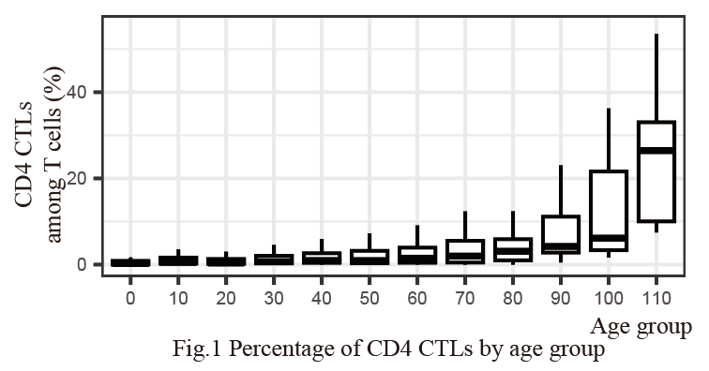
Fig. 1
Caption: Percentage of CD4-positive cytotoxic T cells by age group.
License:Original content
Usage restriction: This image may be used for reporting on this research with appropriate credit.
Credit: Kosuke Hashimoto, The University of Osaka
Title: CD4 CTLs in Supercentenarians: Signs of Adaptive Expansion in Healthy Aging
Journal: Cell Reports
Authors: Kosuke Hashimoto, Miki Kojima-Ishiyama, Hajime Inokuchi, Michihira Tagami, Takashi Sasaki, Kenji Mizuguchi, Yasushi Okazaki, Ichiro Taniuchi, Kazuyoshi Ishigaki, Nobuyoshi Hirose, Piero Carninci, and Yasumichi Arai
DOI: 10.1016/j.celrep.2026.117728
Funded by:
Japan Society for the Promotion of Science
Takeda Science Foundation
The Mochida Memorial Foundation for Medical and Pharmaceutical Research
Article publication date: 19-AUG-2026
share