



ACHIEVEMENTSIPR The University of Osaka
-

- ACHIEVEMENTS
- Savory or sweet? How a new understanding of taste receptors might tickle your taste buds
Press Release
2026.09.30
Savory or sweet? How a new understanding of taste receptors might tickle your taste buds
A team including researchers from UOsaka reveals the first structure of one of the umami taste receptors, showing how a single pufferfish receptor can detect an unusually wide range of amino acids, opening the door for new taste experiences for people
Osaka, Japan – Our sense of taste is critical for survival, alerting us to substances that provide vital nutrients and those that might poison us. Now, a team led by researchers from The University of Osaka has discovered how one such taste receptor in pufferfish can detect a surprisingly wide range of flavors at once.
In many vertebrates, taste receptor type 1 (TAS1R) is the protein family responsible for detecting macro nutrients and preferred tastes. Taste receptor genes across most vertebrate species are surprisingly consistent, designed to detect amino acids, sugars, or nucleotides, although which ones they detect vary. However, the structural basis for the recognition of different chemicals and their specificity in TAS1Rs, particularly the umami receptor family, remains largely unknown because of difficulties in sample preparation.
The research team determined, for the first time, the 3-D crystal structure of pufferfish Tas1r1/Tas1r3, a macromolecule that is part of the TAS1R1 and TAS1R3B group of proteins and that acts in a similar way to the human umami receptor, TAS1R1. The pufferfish receptor was found to respond to a much wider range of amino acids compared with the human umami receptor. Moreover, unlike in humans, pufferfish receptors demonstrate a rare stereochemical flexibility in binding to both savory L- and sweet D-amino acid variants.
“We believe that the pufferfish’s diet drives this molecular evolution,” says senior author Atsuko Yamashita. “They eat a lot of mollusks and crustaceans, which contain high amounts of D-amino acids. Generally, TAS1Rs are considered to discriminate L- and D-amino acids and sense only one of them. The ability to taste both forms may help the fish detect a wider range of savory amino acids in their foods.”
The team identified for the first time the molecular structure and interactions that allow the receptor to bind to both types of amino acids, broadening taste detection in pufferfish. Normally, each taste receptor works like a clamp that closes around a target amino acid to switch on a taste signal. The wrong amino acid prevents the molecular clamp from closing, thus blocking the signal. The team found extra internal connections—described as molecular “latches”—in the pufferfish receptor that hold the clamp shut even when the molecular fit is imperfect.
“Normally, a receptor is unable to bind onto a molecule that is the wrong shape,” explains Yamashita. “Discovering how the Tas1r1/Tas1r3 receptor structure acts like a latch, holding either an L- or D-amino acid molecule in place, is an exciting breakthrough in understanding how receptors can evolve to be more flexible.”
The research findings will contribute to a better understanding of taste perceptions as well as the development and design of new umami flavors for humans and feed for livestock and fisheries.
###
The article, “Identification and structural characterization of stereochemical promiscuity in a taste receptor,” will be published in Proceedings of the National Academy of Sciences of the United States of America at DOI: https://doi.org/10.1073/pnas.2534924123
Summary
A team led by researchers from the University of Osaka has revealed the first structure of an umami taste receptor. They found that the pufferfish receptor can sense many more amino acids than the human receptor, including some linked to flavors humans detect as sweet. This helps the fish to detect more types of savory chemicals in their food. The research also shows how the receptor’s structure makes this flexibility possible. The findings could help develop new umami flavors.
X
UOsaka researchers are first to identify the 3-D structure of an umami taste receptor in pufferfish that also binds molecules linked to sweet taste in human
@UOsaka_en
Primary Keyword
Biochemistry
Additional Keywords: Structural biology, biophysics, molecular evolution, biomolecules, taste receptors, G protein coupled receptors, stereochemistry, protein structure
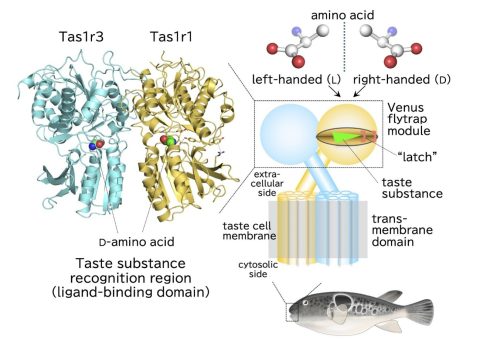
Fig. 1 Caption: Schematic diagram of a pufferfish taste receptor showing the structure of its taste substance recognition region License: Original content Usage restriction: Credit must be given to the creator. No derivatives or adaptations of the work are permitted. Only noncommercial uses of the work are permitted. No modifications of the work are permitted. Credit: Atsuko Yamashita
Title: Identification and structural characterization of stereochemical promiscuity in a taste receptor
Journal: Proceedings of the National Academy of Sciences of the United States of America
Authors: Rakuto Mizoguchi, Yasuka Toda, Mana Nagae, Takashi Yoshida, Hiroaki Matsuura, Kunio Hirata, Vi Toan Lam, Duy Phuoc Tran, Akio Kitao, Yohei Miyanoiri, Maiko Hosotani, Yuji Ashikawa, Chiaki Ito, Naotaka Tsutsumi, Norihisa Yasui, Yoshiro Ishimaru, Atsuko Yamashita
Funded by:
Japan Society for the Promotion of Science
Japan Agency for Medical Research and Development
Japan Science and Technology Agency
Society for Research on Umami Taste
Takeda Science Foundation
OU Master Plan Implementation Project
Lotte Shigemitsu Prize
Article publication date: 15-SEP-2026
share